

By Max Uechtritz
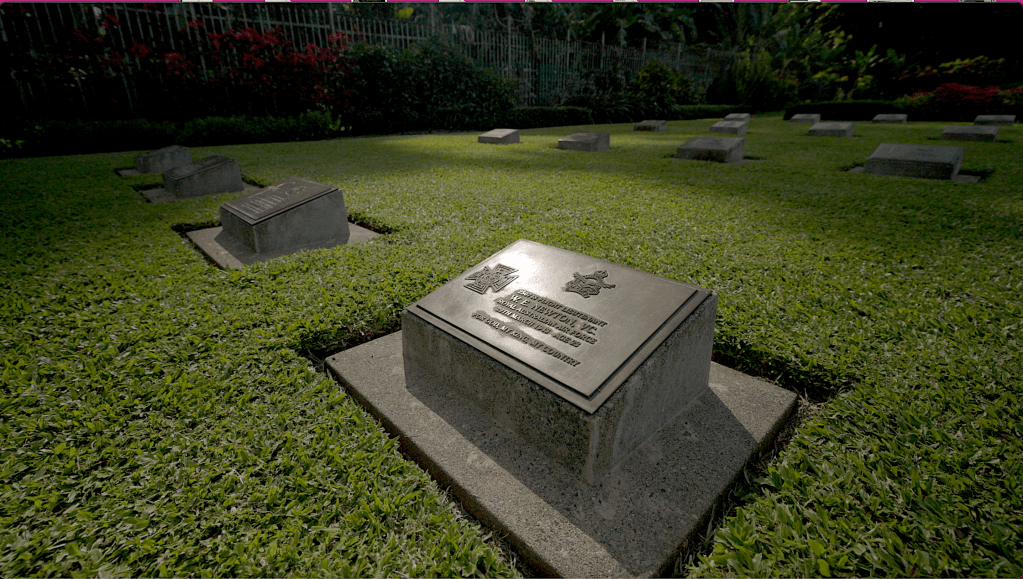
Last week in my first visit in three decades back to my old home town Lae, PNG, I made a poignant visit to a special place to honour a special Australian. Bill Newton VC lies in the beautifully-kept commonwealth war cemetery, a serene site so at odds with the mayhem and carnage of a war which stole so many young lives. Newton was beheaded in 1943. He was 23 years old. His story is forever linked to two old Lae families close to mine.
Dashing, charismatic, an all-round sports star. A cricketing prodigy who represented with Test greats Keith Miller and Ian Johnson and once bowled Bill Ponsford.
A young Aussie rules champion who’d “run through brick walls to get the job done”.
A bomber pilot who flew through walls – walls of murderous anti-aircraft fire – to do just that when “the job” became life and death.
Above all, Bill Newton VC was brave beyond belief.
He’s one of those great Australian stories most Australians don’t know.
The only RAAF flyer to receive the Victoria Cross in the WW2’s Pacific theatre – the only one ever while serving in a RAAF squadron – Bill Newton became an inspiration to generations of Australian airmen.

His name adorns the walls and trophies of Melbourne Grammar School, the Royal Melbourne Golf Club and Fitzroy RSL, while the William Ellis Newton Steeplechase is run every year on ANZAC day and his medals are displayed in the Hall of Valour at the Australian War Memorial.
But too few Australians know of this selfless ace – captured and beheaded in a documented Japanese Bushido ceremony after ditching his flaming Boston bomber into the sea in New Guinea and swimming ashore in March 1943.
Bill had been a prize capture by the Japanese. They named him as “The Firebug” and “blue cap” – for the baggy blue Victoria cricket cap he wore on missions. He flew so low on bombing runs, they’d recognise him in the cockpit, skimming coconut trees, ignoring dense ack ack and machine gun fire to hold course and drop his payload on vital targets.
Two days before he was shot down, Bill had nursed his crippled bomber 180 miles back to Port Moresby where ground staff counted 98 bullet holes in the aircraft. Undaunted, he returned within 48 hours in a different aircraft.As he bombed his designated target, Newton’s Boston was hit by flak and burst into flames.
Attempting to save his crew, Newton flew along the shore, as far from Japanese positions as possible, and ditched the burning aircraft into the sea.
As the aircraft sank, two men were spotted swimming for the shore, about 900 metres away.
The two men in the water were in fact Newton and Sergeant John Lyon. The following day, they were captured by the Japanese and taken to Lae, where Lyon was executed by bayonet. Newton was taken back to Salamaua and beheaded on 29 March 1943. The third crew member, Sergeant Basil Eastwood, had been killed in the crash.
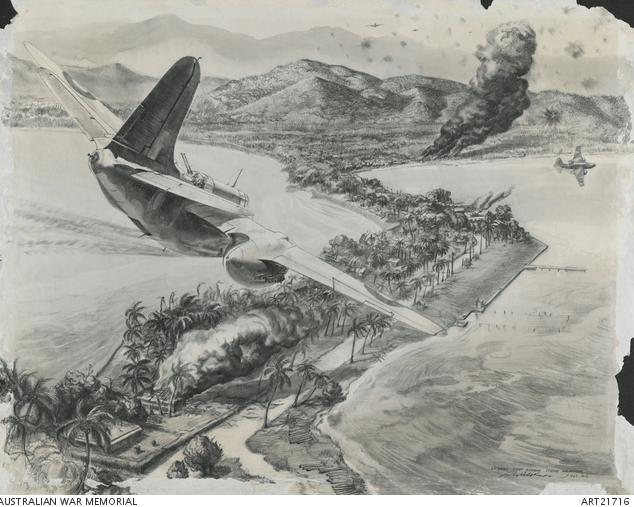
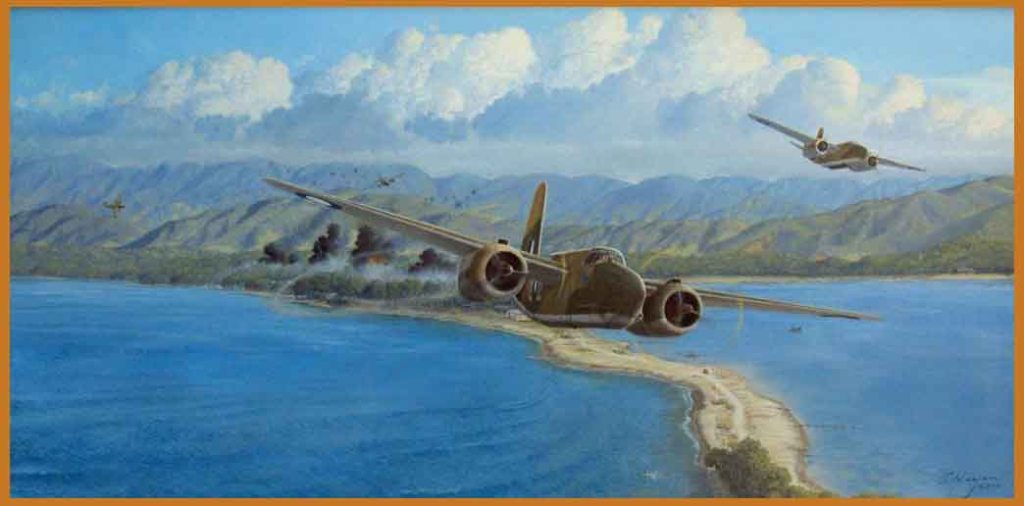
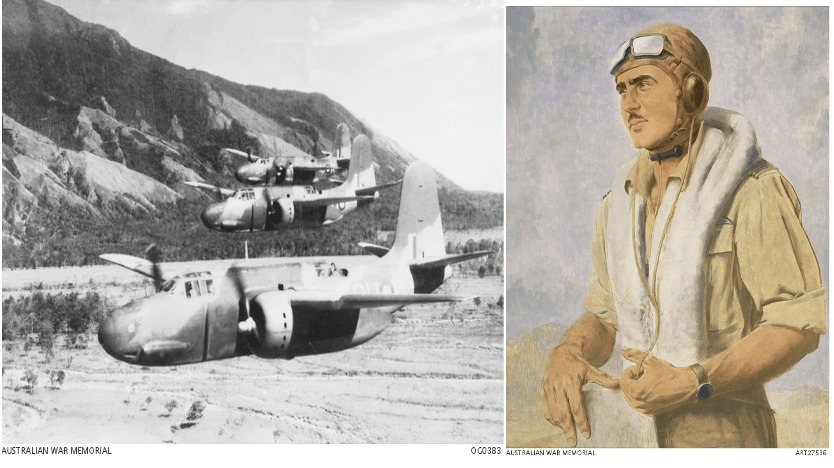
Bill’s execution and the accompanying ritual were recorded in graphic detail in the diary of a Japanese officer. William Ellis Newton was 23 years old. The painting below is of his last flight.
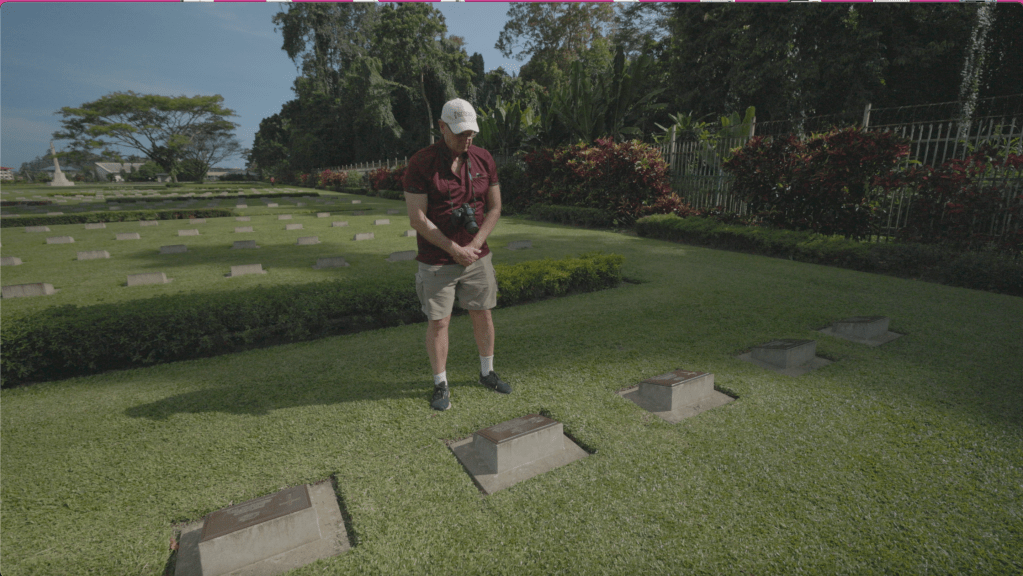
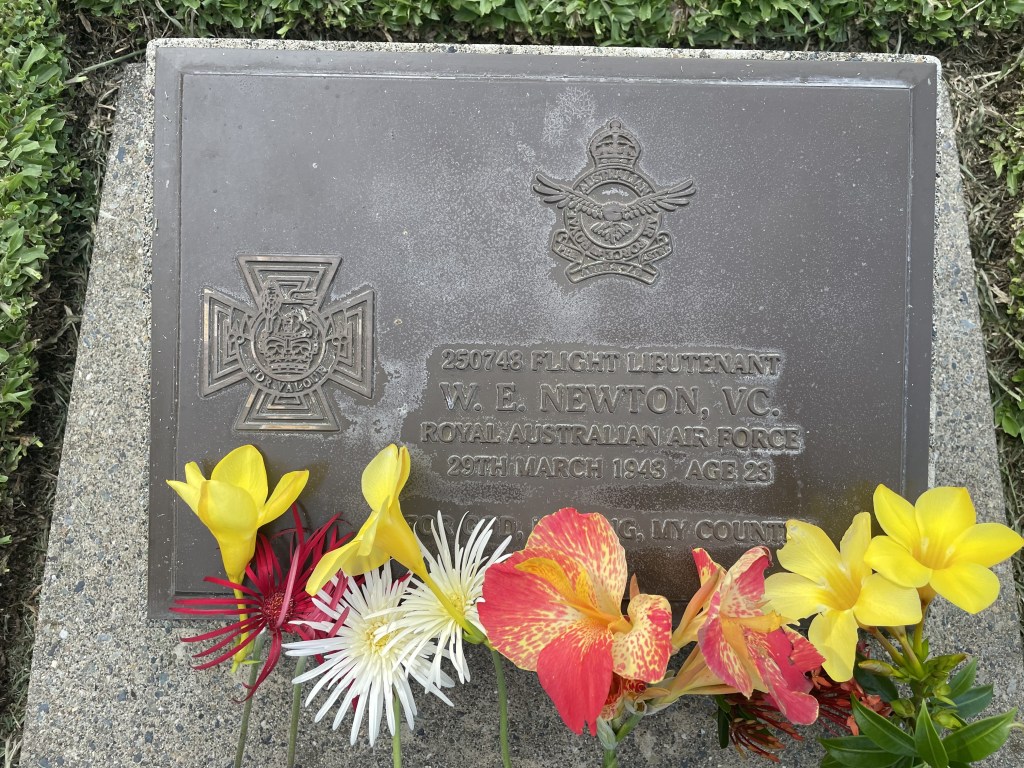
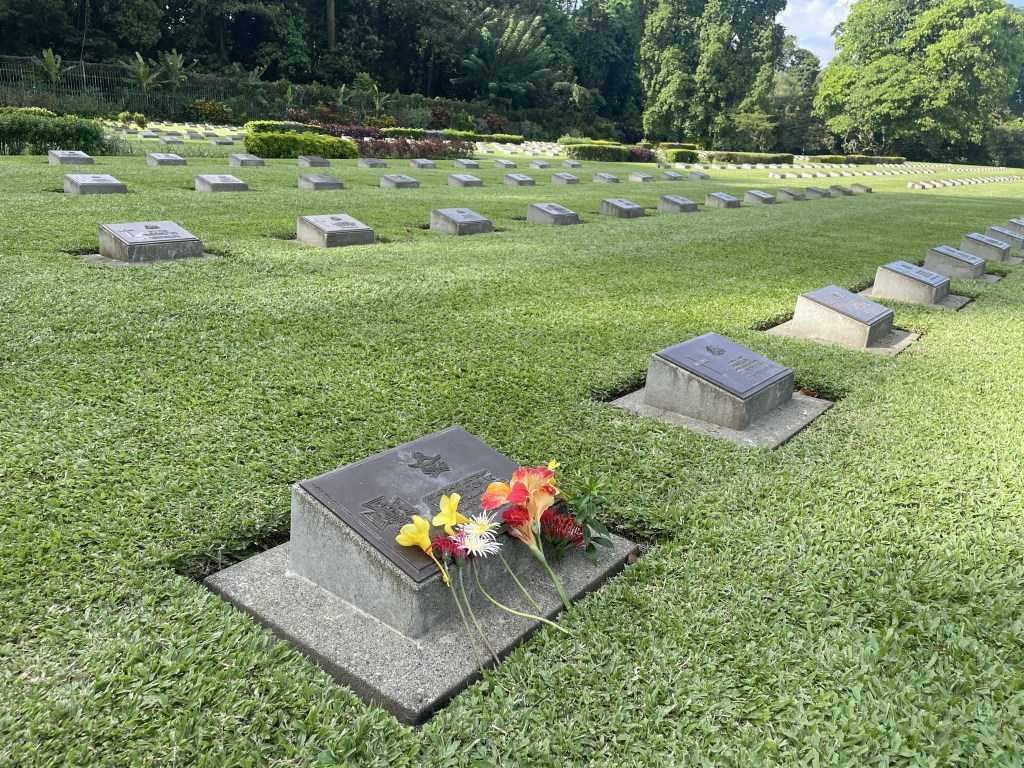
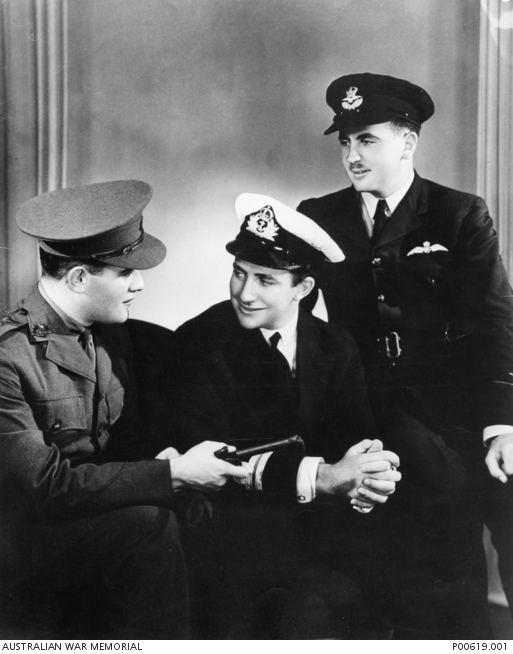
As I picked some tropical flowers at the cemetery to lay on Newton’s gravestone, I thought of course of his family and descendants, some of whom I’ve been lucky to meet over the years. One is the airmen’s nephew Nick Newton who grew up hearing stories about him from his father, Bill’s brother Lindsay. Nick’s eldest son, William Ellis Newton, is named in his honour. Another descendant is Adam Joseph who has long campaigned for the story of Bill Newton VC to be more widely known. A treasured family photograph is displayed above. It’s a studio portrait of the three brothers, Lindsay Newton, a dentist in the Australian Army Medical Corps, Surgeon Lieutenant John Newton, Royal Australian Navy, and Flight Lieutenant William (Bill) Newton, Royal Australian Air Force. The photograph was a spontaneous idea after the three brothers met by chance at the Hotel Australia in Melbourne. It would be the last time they were all together.
I also thought of the personal quirk of fate and my loose link to the Newton story via two families close to the Uechtritz clan as we grew up in there Markham Valley, Lae – and our holiday homes at Salamaua.
Carl Jacobsen was the father and grandfather of our Jacobsen family friends. Carl was responsible for the retrieval of Bill Newton’s body. After the Australians re-took Salamaua from the Japanese, locals took him to the spot where Newton was beheaded. He drained the crater and found Bill’s headless body and took it to Lae to be buried with 2,809 other Australians.
Rod Pearce, longtime Lae resident now living in Rabaul, is the other close personal connection. Rod has spent a lifetime diving and discovering wartime wrecks in PNG. He wants to locate the wreck of Newton’s Boston. No story and no quest or mystery is closer to his heart – because Bill Newton was a dear friend of Rod’s parents.
His dad Eric played football, cricket and tennis with him at school and his mother Damaris jived and waltzed with Bill and his friends at the big, pulsing St Kilda hall “Palais de Danse” in the pre-war years.
Rod would like to locate the Boston bomber on the seabed less than a mile off Salamaua – a picturesque pre-war Australian isthmus town and then wartime Japanese stronghold, now a sleepy settlement and secluded holiday haven. In an incredible coincidence, Rod’s parents moved to nearby Lae in the 1950s and his family owned a weekend house at Salamaua for decades. The proximity – not far from Bills execution site – moved Rod’s mother to write a tribute.
Rod’s mother Damaris sat on the steps of that house in 1974 – gazing out to where the bomber went down – and penned a poignant poem about her friend Bill.
SALAMAUA: In memory of Bill Newton and the crew of A28-3.
Here where the bamboo makes
Black patterns on the sand,
Softly the water takes
Pebbles, on to the strand.
There, where the green hill rise
Clasping the land-locked bays
None but the quiet bird cries
Breaking the calm always.
Swift tho the years pass by
Not yet forgotten quite
Horror and blood did lie
Split by an armoured might.
Alone on this alien shore,
Blue sky and laughing crest,
These were the last he saw
Here let his memory rest. D.B.Pearce, Salamaua 1974
 Max Moments